Mean draft is the average of a ship’s forward and aft drafts. When a midship draft is also provided, Hindship and draft-survey calculations commonly use the mean of mean of means.
Use the following sequence to keep the drafts, units and signs clear.
1. Average the port and starboard drafts
When both sides are given, calculate one average draft at each position before continuing.
F = (Forward Port + Forward Starboard) ÷ 2
M = (Midship Port + Midship Starboard) ÷ 2
A = (Aft Port + Aft Starboard) ÷ 2
2. Calculate the mean draft
The simple mean draft is the average of the forward and aft drafts.
Mean Draft = (F + A) ÷ 2
This value does not by itself account for hull deflection indicated by the midship draft.
3. Calculate the mean of mean of means
When forward, aft and midship drafts are available, use:
Mean of Mean of Means = (F + A + 6M) ÷ 8
Worked example
A ship has the following observed drafts:
- Forward: Port 7.96 m, Starboard 8.00 m
- Midship: Port 8.26 m, Starboard 8.40 m
- Aft: Port 8.58 m, Starboard 8.64 m
Step 1. Average each pair
F = (7.96 + 8.00) ÷ 2 = 7.980 m
M = (8.26 + 8.40) ÷ 2 = 8.330 m
A = (8.58 + 8.64) ÷ 2 = 8.610 m
Step 2. Calculate the simple mean draft
Mean Draft = (7.980 + 8.610) ÷ 2 = 8.295 m
Step 3. Calculate the mean of mean of means
(7.980 + 8.610 + 6 × 8.330) ÷ 8
Mean of Mean of Means = 8.32125 m
Trim and hull deflection
Observed Trim = A − F
Observed Trim = 8.610 − 7.980 = 0.630 m by the stern
- If the midship draft is greater than the simple mean draft, the vessel is sagging.
- If the midship draft is smaller than the simple mean draft, the vessel is hogging.
Mean draft is not always the hydrostatic draft
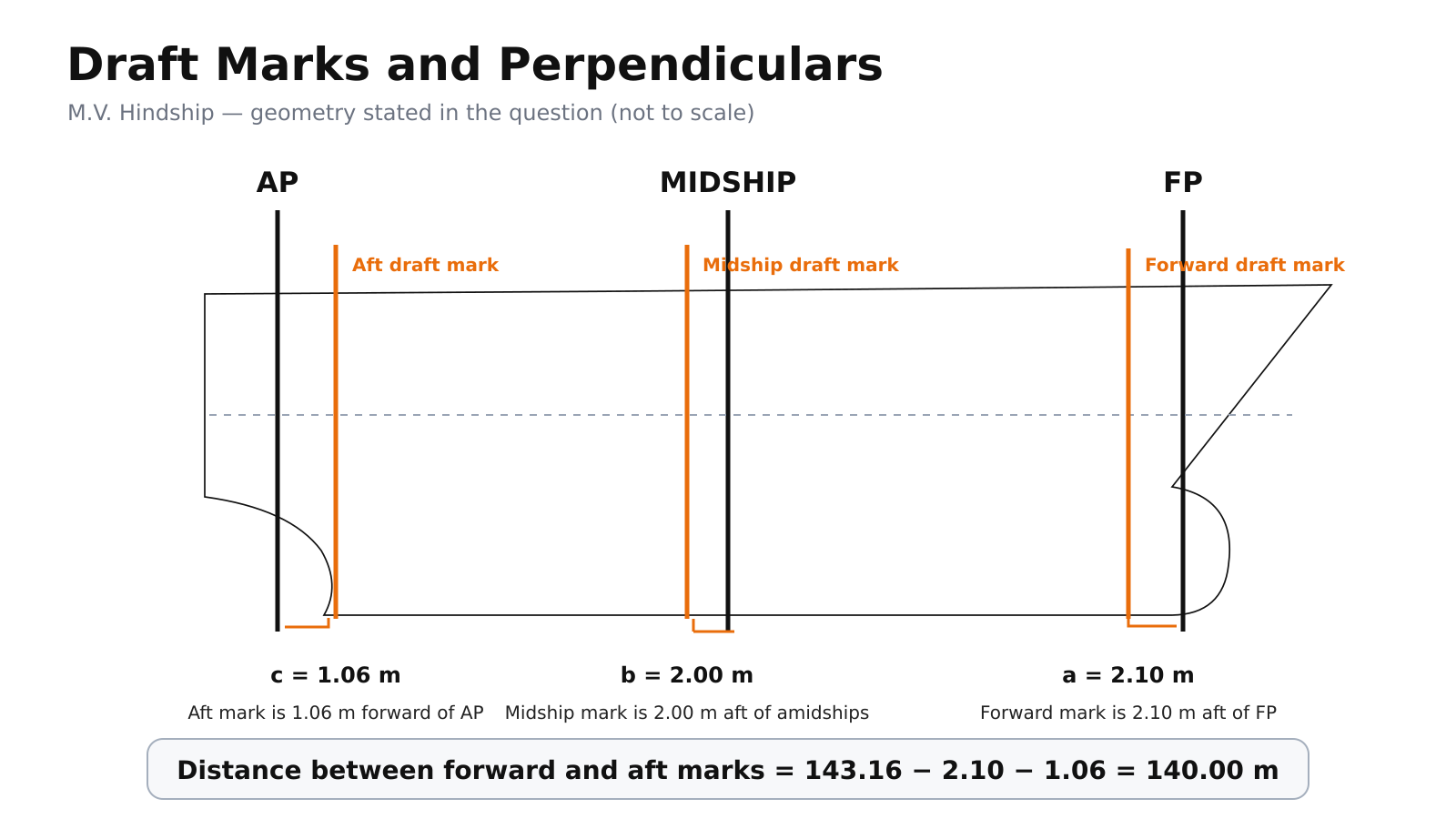
Before entering the hydrostatic tables, check whether the observed marks must be corrected to FP, amidships and AP. A first trim correction may then be required to obtain the hydrostatic draft at the tabulated reference position.
Do not enter the hydrostatic tables using an uncorrected draft unless the question permits it.
Common examination mistakes
- Using one side’s draft instead of averaging port and starboard.
- Confusing mean draft with the mean of mean of means.
- Ignoring the midship reading when hogging or sagging is present.
- Reversing the sign of trim.
- Using observed drafts without correcting them to the perpendiculars.
- Entering hydrostatic tables before applying the required trim correction.
- Rounding intermediate values too early.
- Leaving units out of the working or final answer.
Educational material for examination preparation. Always follow the applicable official syllabus, approved ship data and examination instructions.
Chief Mate Hindship Course
Continue with nine complete examination-style problems.
- Written solutions
- Video explanations
- Formula-first working
- 180 days of access
₹499 regular price
₹399 launch price
One-time payment. Access is normally activated automatically after successful payment.